What a Happy Thanksgiving for retailers. Holiday sales were up 12.8% from last year’s Black Friday. Retailers moved their promotions to begin on Thursday, and based upon the data this was a good move. Retail sales for the Holiday weekend came in around $59 billion. The question is: Will this keep up through the rest of the year? According to the National Retail Sales Federation, retail sales during the holidays account for roughly one third of all retail sales for the year and 40-50% of the profit for these companies. If this continues, we could see a good rally in the markets throughout the rest of the year. However, if this is just a reflection of stores opening early on Thanksgiving and cannibalizing later sales, we could have a very difficult end of year and first quarter of 2013.
Granite Group Advisors
We are a new breed of consulting firm with a defined and proven process to protect and grow our clients' wealth

Category Archives: Uncategorized
Mideast and oil
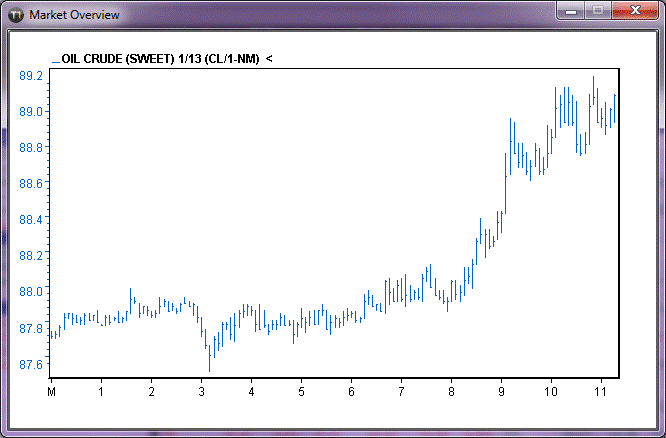
Over the weekend Israel prepared a ground offensive of the Gaza strip. Oil prices are moving up as a result of these actions (see intraday chart below). The price move reflects a worry about escalation of war spreading to oil producing countries. If a cease fire is announced, oil prices start to fall back again. If a compromise cannot be found in the short-term, the cost of goods and services will increase. We hope that a peaceful solution can be found, but if this situation persists, oil stays up and net earnings will be negatively impacted.
Have a Happy Thanksgiving!
Time for action
The election is over and now the political world must act to keep our nation from falling off the so called “Fiscal Cliff”. The first batch of rhetoric, from the House of Representatives, was relatively conciliatory with the idea that we will have to compromise and work together. However, both the Senate majority leader and the President’s rhetoric was tax the rich. If nothing is done there is a good chance our US debt will be downgraded which in turn will put additional pressure on the markets. We believe something has to be proposed by year end.
Here is what we think should happen for the benefit of the country:
- Extend Bush Tax cuts because the economy is too fragile
- Simplify the tax code
- Reduce government spending across the board, including fixes for entitlement spending such as Social Security and Medicare/Medicaid
- Have a budget, with a proposal to pay down debt.
If Washington cannot agree on a solution, there will be higher taxes for all of us no matter the income level. This will throw us into a recession and impact any growth going forward. We also have a debt ceiling fight within the next few months that needs to be part of this conversation. We hope a solution can be found as the alternative is negative for everyone.
The Fiscal Cliff
Over the weekend the G20 met in Mexico to discuss many of the economic issues facing the globe today. While Europe is of concern to everyone the main issue that came out of the meeting was the U.S. and the impending fiscal cliff. Most of the G20 members are very concerned that if the U.S. does not act quickly things will go very badly for the rest of the world. The problem in dealing with the fiscal cliff is that there is no easy answer. If the government raises taxes they will slow the economy down. If they keep spending without austerity they create an even bigger hole in the deficit. The only solution for the U.S. is to grow our way out and with expensive policies such as Obamacare and other such regulations, there is stagnation in the economy resulting in slow growth. Regardless of who gets elected tomorrow there is a lot of work to do and quickly. The markets will respond to positive movements in pro-growth policy but if we stay on the current path the U.S. will eventually become another Japan with 20 years or more of stagnation.
Earnings Slowdown
This morning, Caterpillar slashed its 2012 forecast for the second time this year as it warned the global economy was slowing faster than it had expected. This announcement comes on the heels of last week’s disappointing earnings from the likes of Microsoft, Google and McDonalds. While many Wall Street analysts have lowered expectations for earnings this quarter, the fact that these big conglomerates are lowering their forecasts for the future is quite disheartening. We have talked before about earnings reaching their peak earlier this year and unfortunately this is coming to fruition. Our take for some time has been that the market was ahead of itself, and Friday’s pullback put this in the spotlight. We still see the market trading in a bit of a range as cautious investors are watching how the rest of this year will unfold. With all the headwinds of the election as well as the impending fiscal cliff, the road could get a bit bumpy from here.
Earnings Season
It is earnings season again on Wall street. We kicked off last week with mostly good numbers but at the same time see forecasts for the upcoming quarter a little dampened. This combined with the never ending Europe story caused markets to take a nice dip. Negative earnings expectations are predicted to be the highest since the 1st quarter of 2009, see below:

Adding fuel to the fire is the fact that while the S&P 500 continues to go higher, earnings expectations are falling, as illustrated below. This means that Wall Street is concerned about our economic recovery. We expect to be in a trading range here for a while as valuations have discounted the slow economic backdrop, but any catalysts such as QE3 actually working or some change to the EU situation will drive the market higher.

Jobless rate falls?
This morning the monthly jobs report was issued and we created 114,000 jobs. From our perspective this is just an average number and does not match the number of new people entering the workforce. Interestingly, the unemployment rate dropped by 0.3%, so how can that be? As we were combing through the data, we noticed a bizarre anomaly in the calculation. The household survey which is used to calculate the unemployment rate went dramatically higher in the last month. Roughly 875,000 jobs were added based upon this survey. The survey is based upon the fed calling and interviewing roughly 60 thousand households. Somehow out of nowhere everyone starting working as this is the biggest gain in the household survey since June of 1983 and more than double the size of previous months . We believe there is something fishy in that data. The household survey is a sample and it spiked so high, we smell a rat. Our expectation is that this will be adjusted downward by a relatively big amount in the next report.
Below is a chart showing the change in the household survey. Notice the unlikely spike:

Slowing Manufacturing
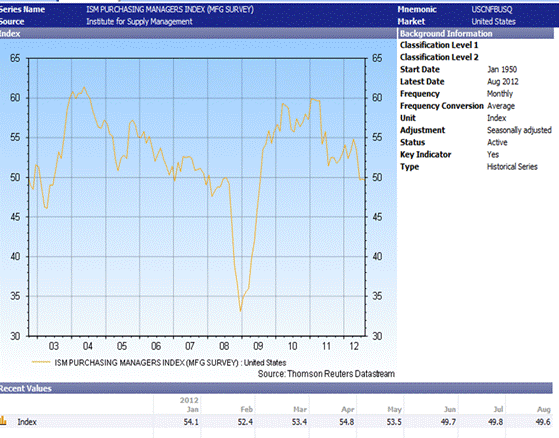
This morning there was more news of slowing growth in manufacturing in both Asia and Europe as well as last week’s news that durable orders shrank. The Unites States Purchasing Manufacturing Index (PMI) had a below 50 reading which translates to a contraction. The markets are currently shaking off all this bad news and moving slightly higher but this is not good news for the 3rd qtr GDP report, which from Granite Group’s perspective maybe below expectations. In China we have seen seven straight months of contraction. In Europe, while there was some stabilization from Germany, Spain and others, the UK saw an unexpected drop. We do not see this changing anytime soon. The S&P’s 4th highest run in ten years has ignored the data in favor of QE3 and inexpensive market valuations. Granite Group believes with a fair valuation at hand the markets might finally stall when equity owners wake up and smell the coffee.
Talk is Cheap
While the European Union has been talking about making strides at working out the 3 yr old debt crisis, nothing has actually been done yet. Germany’s business confidence fell unexpectedly and may be headed into recession; Spain continues to run into squabbles with Germany and the European Union on the possibility of a bailout for their banks. Economic news reinforces the message of lackluster global growth. Even with the ECB stepping in two weeks ago we believe Europe will stay in a recession. The Euro area expected growth for 2013 is approximately .8%. Although the most recent injection of liquidity on both sides of the pond traditionally calm markets, the government debt as a % of GDP in the Eurozone is still at 90%. This should persist and cause problems in the capital markets down the road.
Easy Money
On Thursday afternoon the Federal Reserve announced another round of quantitative easing (QE3). They will be buying 40 billion dollars worth of mortgage backed securities every month for the forseeable future. Additionally, they will continue their zero interest rate policy until mid 2015. This tells us that the economy is not in good shape. If it were there would be no need for QE3. Stocks, gold and oil will benefit the most, as printing money debases our currency and creates commodity inflation. This will hurt the ones who need the help the most by increasing the cost of everyday items.
Historically the Fed’s decision has been good for equity markets, but as far as we are concerned this is the last of the fed’s ammunition. Last week’s market reaction was expected, but will be unsustainable going forward. Additionally, The Fed said that these policies will stay in effect until we have better employment growth. We don’t believe these transactions will do anything for real employment growth, and since wage inflation is the key component of core inflation, we do not think there will be any. Unfortunately our economy will not heal until there is real employment growth.
 Granite Group Advisors