Category Archives: Uncategorized

A volatile time ahead

We are beginning to enter a short term cycle of uncertainty and volatility.  The problems will be policy oriented rather than economically oriented.  In the upcoming months we will have a debt ceiling debate and a fight over the funding of Obamacare, either of which could potentially shut down the government.  

Additionally, the Federal Reserve, after their meetings in September,  will probably start tapering their purchases of Treasuries. The problems that have been ebbing and flowing from the Middle East are sure to cause volatility as well.  The markets do not like uncertainty, and with all the issues at hand, uncertainty is there.  With all that being said, equities are  fairly valued , and we do not see a major dislocation happening in the markets. Any further downturn will most likely rebound by the end of the year, albeit probably not to the tops we reached earlier this month.  It is important to remember that markets do not go straight up without some healthy corrections.  Assuming we will go through a corrective phase, this will not be permanent or long-lasting.   

You can follow Granite Group Advisors on LinkedIn and learn more about our Corporate Retirement Services and Wealth Management in our Website.

How to decipher the data

There are lagging indicators and forward indicators. The lagging indicators are unemployment, jobless claims, GDP, etc…and the forward looking indicators are ISM, consumer confidence, building permits etc.  The rule of thumb is an ISM reading of over 50 is an expanding economy, and under 50 is a contracting economy.  The last week and a half we have had the joy of receiving a bevy of economic data that should have indicated where our economy stands. 

Let’s start with the lagging indicators, the GDP report for second quarter was better than expected at a 1.7% growth in the economy (1% was expected).  Wall street loves better than expected numbers and the markets reacted positively.  However, the revisions to first quarter’s GDP, from the original 2.4% to a final reading of 1.1%, does not bode well for the revisions coming for second quarter. Payrolls came in worse than expected at 162,000 new jobs created, but the unemployment came in at a better than expected at 7.4% rate. This does not make sense until one looks further into the data and realizes that almost a million people left the workforce. We are now at the lowest employment participation rate our country has ever seen. The job report also tells us there is a structural shift in employment from full-time to part-time work as income growths are stagnant, as well as hours worked.  Pending home sales also dropped a little bit.

The forward (leading) indicators like ISM manufacturing numbers came in at 55.4% which was much better than expected. Also the ISM Non-manufacturing came in at 56, which was a big surprise to the upside. Consumer confidence came in at 80.3 which was lower than expected, but near a multi-year high.

So how does one decipher all the data? The lagging indicators were not great, with the exception of the first estimate of 2nd quarter GDP, but as we have stated above, it is a recap of what has occurred. The leading indicators were all strong, and are predictors of what will potentially happen. We believe that one should look at where the economy is going, not where it has been, as more of an accurate predictor. The market move up has predicted the recent round of numbers, but Granite Group would argue that a lot of the short-term good is already in the market valuation. We believe 2014 could hold on to some of the 2013 gains, but most certainly not at the increases we have seen so far in 2013.

You can follow Granite Group Advisors on LinkedIn and learn more about our Corporate Retirement Services and Wealth Management in our Website.
Earnings Season

In the last couple of weeks we have seen quite a move in both Equities and Bonds.  We had our first pullback of the year in equities, with the S&P dropping 5.76% from its peak in May, only to be followed with a revival of the S&P, to new highs as of yesterday. Click for a larger image
Rich Picture1 copy


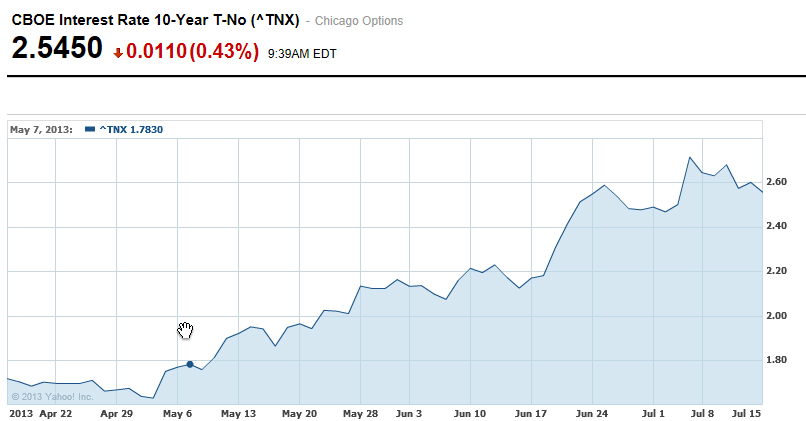
In bonds, there has been a major re-pricing based upon the Fed removing or slowing down stimuli.  The ten year treasury went from a yield of 1.7% all the way up to over 2.7%, which is an incredibly big move for bonds.

Rich Picture2 copy

It is time to get down to fundamentals and what really moves the markets, earnings.  This season will be particularly interesting as many companies have guided lower towards lower earnings.  If this comes to fruition, we will most likely pull back again as we are currently trading at 15.5 times earnings which we consider to be ahead of a slow growing economy.  Companies reporting have mostly beaten expectations but we have a lot more earnings reports coming out in the next few weeks which will guide the markets from here.

You can follow Granite Group Advisors on LinkedIn and learn more about our Corporate Retirement Services and Wealth Management in our Website.

Tagged

Rollercoaster

This week marks the beginning of the quarterly meeting of the Federal Reserve. On everyone’s mind is when will the Fed start to taper its purchases of debt? Our perspective is that the Fed is currently in a very difficult situation, as the markets are almost completely trading on this issue, and the Feds know it. If they taper, the bond vigilantes will drive up yields and equity markets will probably come off a bit as the stimulus which helped both markets will no longer be there. Since the Fed has tipped its hand, we have seen more triple digit moves in the dow than we have seen in a long time. We reached an intraday peak on May 22nd and since then we have had more than 10 days of the market moving over 100 points in either direction. At the end of last week the DJIA was down approximately 3.2% from the intraday high to the intraday low. We are starting this week with another 100 plus point positive move. What will tomorrow bring or even what will this afternoon bring? Welcome to the rollercoaster. It probably will not end until we all get some clarity from the Federal reserve.

You can follow Granite Group Advisors on LinkedIn and learn more about our Corporate Retirement Services and Wealth Management in our Website.
The economy: not too hot…not too cold

We have had a bevy of economic data this week which will support the Federal Reserve’s continuation of Quantitative easing programs. Here are the reports from this week:


The Good                                                                                                           

Auto sales which came out better than expected                          

The ISM services came in better than expected                             

The Fed beige book report showed the economy modestly or moderately growing


The Bad

The ISM manufacturing report came in below expectations

This morning’s jobs report was better than expected but not a blockbuster report by any standard


Investors this week were focused on the Fed’s bond buying program coming to an end, but when all said and done, it looks like the fed will continue its buying program beyond investors expectations.  As of this morning, the liquidity driven market will continue.


Our perspective: the economy has definitely slowed, but not dramatically. The printing presses are on for now.  The best way to put the economic scenario into context is:  We are in a goldilocks scenario with the Fed and equity markets, but sometime soon, the bears will be coming home…but not yet.


You can follow Granite Group Advisors on LinkedIn and learn more about our Corporate Retirement Services and Wealth Management in our Website.

The housing market, a closer look

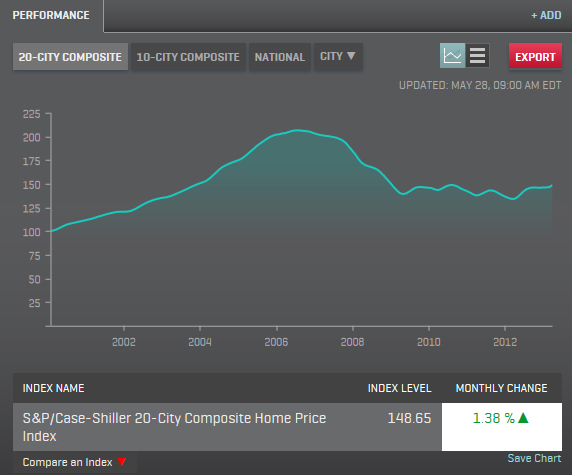
In early 2006, according to the Case Shiller real estate index, we reached an all-time high on housing prices.  Since that time, there have been many discussions on the health and rebound of the housing market. The market low was 34% down in March of 2012.  Currently, housing prices are about 30% lower than the peak of 2006. Are these statistics telling the whole story?  We think not.

1

While we have had a mild recovery from the bottom, we are still quite far from a robust housing market.  There has been some rebound in prices and volume of sales, but much of it is coming from the places that were hurt the worst during the housing crash:   Arizona, Florida, Nevada and California.  According to Case Shiller, prices are up over 10.9% year on year in prices nationwide.  However the troubled states are up over 20% in prices.  If this data seems somewhat skewed, it’s because it is.  If you think about the historically low interest rates, you would expect a much more robust housing market than what the statistics show.  These big increases are coming from such low levels that percentages mistakenly make the data look better than it actually is.

3

We still have a long way to go to get back to a reasonably robust housing market.  We reiterate that demographics are not favoring housing demand.  It is time to be cautious about this sector, especially if the 10 year treasury continues to be moved upward in yield.  Most 30 year mortgages are based on that rate. We do believe that housing prices are improving, but we are not in a booming housing market by any measure.

You can follow Granite Group Advisors on LinkedIn and learn more about our Corporate Retirement Services and Wealth Management in our Website.

Is the party over?

       In our previous blog we discussed the consequences of the Federal reserve removing their easing and stimulative policies.  Yesterday the Fed minutes indicated this could start happening as early as June. The markets responded by selling down a bit.  Today, Chinese manufacturing came in below the growth line and Asia as well as Europe sold off quite hard.  In the U.S., both sets of information are at play as we are selling down.  The well documented potential negative reaction is unfolding today, but our perspective is that the announcement by the fed that the party may be ending soon will have much longer effects on the stock market.  We don’t think the world is coming to an end, but equity market valuations, based upon the earnings and economic growth, became extended.  This is a healthy start to bringing P/E ratios back to a reasonable number as we are trading at roughly 15 times this years and 14 times next year’s numbers. We normally would only see those type of valuations if the business sector is firing on all cylinders, frankly we are not in that type of environment.

You can follow Granite Group Advisors on LinkedIn and learn more about our Corporate Retirement Services and Wealth Management in our Website.

The end of Fed Easing!

              The spin masters of Wall Street are starting to talk about the fed exiting their strategy of quantitative easing to infinity. It is time to discuss the exit strategy of the fed from its bond buying expansion. Before the crisis began, the Fed held roughly 800 million dollars  of US debt.  Today, the Fed is well over 3 trillion and growing.  At some point the fed buying will have to pullback and eventually stop. Many people are afraid of the effect this will have on the equity and fixed income markets. 


Our take is two-fold, as each fed action will have different effects.  First, when the Fed pulls back or stops buying,  we will most likely see both the equity and bond markets sell down in price. The severity will depend on whether the fed pulls back or stops.  Then second part is: What does the Fed do with trillions of dollars in debt? Depending on the Fed’s actions, selling out of their positions could cause a spike in interest rates. The repercussions would be that borrowing cost will go up and holding a bond will incur a paper loss as the bond market re-prices.  There is no easy way out and Granite Group believes the best way for the Fed to exit is to do it slowly over time.  For fixed income holders, a shorter duration and then reinvesting  bonds as they mature  is a practical solution.  There will be some dislocations when the Fed exits these programs and we are not suggesting that yields will go back to 5% levels anytime soon, nor are we suggesting a 20% correction in the S&P.  We can only hope that if Yellen (or whoever else replaces Bernanke), takes his/her time and does it the best way with the least amount of pain to the markets.  What is certain is that they will have a hard balancing act.    


You can follow Granite Group Advisors on LinkedIn and learn more about our Corporate Retirement Services and Wealth Management in our Website.

Jobs: Better than expected

This morning the jobs report, which is a lagging indicator, came out better than expected at 165,000 (with 145,000 expected).  Revisions to prior months also show more jobs were created previously as well.  While this is welcome news, it is not the kind of growth you would expect in a post-recession economy.  This does tell us that the economy is growing, but growing slowly.  Conversely, on Wednesday the ISM Manufacturing prices paid, came in at 50 — down from the expected 53. Today, ISM Non-Manufacturing, a leading indicator, came in 53.1, expected was 54. Anything below 50 would be considered a contraction. Additionally, Factory orders also missed with a – 4 reading, expected was a -2.6. The fed has its foot on the accelerator and the Fed minutes say this will continue.  The equity markets in this environment may continue to go higher, but we believe the markets are very close to a full valuation.

You can follow Granite Group Advisors on LinkedIn and learn more about our Corporate Retirement Services and Wealth Management in our Website.

1st Qtr GDP: Continued Tepid Growth

      This morning we got our first read on our economy.  1st quarter GDP came in at a 2.5% growth rate well below the estimated 3.0% growth rate.  This was not a surprise as most economic reports were pointing to slower growth than anticipated.  The most interesting aspect of the report was that incomes fell 5.3% from the previous quarter. This does not bode well for the future as spending is the largest component of the US economy. As we have stated several times in our past quarterly commentaries,  the U.S. is growing, but at a slow pace.  Wall Street expected the  GDP to be the best in the 1st quarter, but with this tepid pace we will be lucky to get a 2.0% GDP this year.  The report today affirms our continued slow growth forecast.  Equities will continue to trade at a discounted P/E than the historical average of 15 times earnings. 


You can follow Granite Group Advisors on LinkedIn and learn more about our Corporate Retirement Services and Wealth Management in our Website.